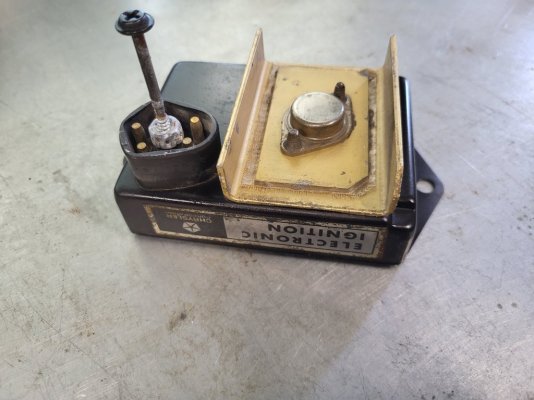
The pictured electronic control unit (ECU) appears to be Chrysler part number 3874020 or 3755550. Following is a summary of the Chrysler production ECUs:
| Part Number | Usage | Pins | Notes |
|---|
| 3438850 | 1971-1972 | 5 | 1971 - 340 manual transmission only. Black case, gold heat sink. |
| 3656127 | 1972 | 5 | 400 & 440 HP manual transmission, engine speed limited. Black case, red heat sink. |
| 3656128 | 1972 | 5 | 340 manual transmission, engine speed limited. Black case, blue heat sink. |
| 3656900 | 1973 | 5 | Improved cold starting. Black case with white dot, gold heat sink. |
| 3755550 | 1974 | 5 | Added radio suppression capacitor. Black case, gold heat sink. |
| 3874020 | 1974 - 1979 | 5 | Added voltage spike protection. Black case, gold heat sink. |
| 4111850 | 1980 - 1991 | 4 | Four pins, two terminal external ballast resistor. Black or blue case, gold heat sink. |
The five pin units are essentially interchangeable for basic function. A four pin ECU can replace a five pin ECU, but a five pin ECU cannot directly replace a four pin ECU unless the associated ballast resistor wiring is backdated to the four terminal ballast resistor. Note that some aftermarket replacement four pin ECUs might have a "dummy" fifth pin.
The simplest, and best, test of the ECU is to put it on a good running vehicle and see if it works, and if it performs okay. Relatively full bench testing can be done with specific test equipment such as the NAPA Echlin 4643 Ignition Module Tester pictured in post #3. This is a NAPA branded version of the Zetron IMT-1000. This unit is handy for testing multiple brands and types of ignitions.
Chrysler provided their own tester from Miller Tools (now OTC) with the C-4166 and C-4166-A. The C-4166-A can test ECUs on the bench and on the vehicle in conjunction with the vehicle wiring, ballast resistor, and distributor pickup. The following image shows my own tester checking an ECU:
View attachment 730398
Chrysler also provided a more universal ignition tester, the 1-3500 Uni-Tester, to test their own and other brand ignition systems. The following image shows a Uni-Tester:
View attachment 730395
The only real bench test with a multimeter or ohm meter is checking pin 5 to case ground. The reading should be essentially zero ohms. The following image shows me checking pin 5 which, neglecting test leads resistance of ~0.2Ω, is close to 0.1Ω:
View attachment 730399
A bad reading indicates the ECU will not work. A good reading only indicates the internal ground is good. The unit might still not work.
Alternatively, without a specific tester, a more full bench test could be set up with a power supply, pulse or signal generator, and oscilloscope, fast capture volt meter or perhaps a frequency counter (with attenuator).
The ECUs can be cleaned and stripped and still work if the worked before, but the process can be tedious and tricky, and component damage is a strong possibility, especially if dealing with potting removal. Components can be replaced to an extent.
Your pictured unit is heavily rusted, but might be cleaned with careful wire brushing and hand brushing of the case, although making it look new will be a task. It could partially be cleaned first by masking the connector and transistor/heatsink, plus cover the back, and carefully bead blasting it. The heatsink is anodized aluminum and might be buffed clean if the anodizing is still intact and the aluminum is not corroding. If it is corroding, heavier brushing might be used, but care should be exercised around the insulating pad. The transistor case is nickel plated steel and it can be lightly hand brushed, but any remnants of marking will be gone, and due to its shape, full cleaning of corrosion will be tricky.
The following image shows a case that was rusted, though not as bad as yours, in the process of being cleaned. The rust removal so for has been with a wire brush by machine:
View attachment 730401
Evaporust can be used in areas that can't be reached with brushing or to get into pits. Some light chemical etching of the external part of case with phosphoric acid is possible. Don't use the phosphoric acid on the heatsink or transistor. The connector pins can be cleaned with a contact cleaner such as CRC or DeOxit brands. Lacquer thinner can be used for some clean up, especially for any potting on the outside.
Your potting does look in decent shape but it can be removed if ever needed. The following image shows some ECUs that I have removed the potting and will be re-potted when any component repair, further case work, and painting is complete:
View attachment 730400
The cases can be repainted after cleanup and new labels are available if desired. The following image shows a couple I have repainted, a P4120505 and an aftermarket version of 4111850. The paint is not the exact color, or sheen, but it's close enough for my use:
View attachment 730404
When repainting, don't paint the heatsink, transistor, or connector. I have used a light coat of VHT high temperature clear on the transistor cap to preserve the marking.
In general, for one as bad as the one pictured, I likely would not try too hard to refurbish it. A refurbished ECU might still fail from damage during the process of refurbishment, or just from age like any. Although I rarely have had an original ECU fail, I only use original Chrysler units or good aftermarket replacement units made over 25 years ago in the USA, when needed. I keep a few on hand:
View attachment 730402