What to do about all of this rot?

darth_linux

Senior Member
Joined
Oct 9, 2022
Messages
1,022
Reaction score
973
Location
Spokane, WA
Somewhere between “replace the entire firewall with a new panel” and “do nothing” exists the solution I will employ. This car is only driven in fair weather, so honestly, there won’t be water getting near these areas except when I wash the car. My current thought is either plug those holes with the black roofing tar that goes in a caulking gun or use some HVAC tape to cover over the holes and spritz with flat black paint. I’m NOT replacing the firewall and I’m not doing “nothing.” What would you do? It’s bad around the wiper motor but worst along the passenger side inner fenderwell.

IMG_4632.jpeg


IMG_4633.jpeg


IMG_4634.jpeg


IMG_4635.jpeg
 
That large oval hole in first pic is a cowl drain. Do not plug that. A rubber flap covers it, mount ps in thos 2 small holes above. The rust hole next to it goes insode the cowl drain area, can leave it there.

The other holes are going inside the cowl drain area. No need to plug, the drilled hole goes to the interior.

Does this car park inside now?
 
I have a new cowl drain flap coming from vans. The car is parked undercover during the winter with either a physical structure or a car cover. Thanks.
 
Can someone answer this - is there a path that water can take (along the red line) to get to the seam that is rusting out behind the inner wheel fender?

cowl1.JPG
 
Can someone answer this - is there a path that water can take (along the red line) to get to the seam that is rusting out behind the inner wheel fender?
Yes, that whole area is open behind the upper firewall panel.

That rust is quite common from leaves, or worse, pine needles, collecting in the cowl.

The good news is those rust holes don't cause water to get in the interior, unlike the B and E cars where the rot is usually on the inside panel.

I would clean off as much of the rust as practical. Back up the larger holes with some fine metal screen, then fill over the holes with long strand Tiger Hair. That repair will last a long time on a car that doesn't see much wet weather.

Jeff
 
Scuff up the areas and use a little fiberglass resin and mat to fill the holes.
^This^

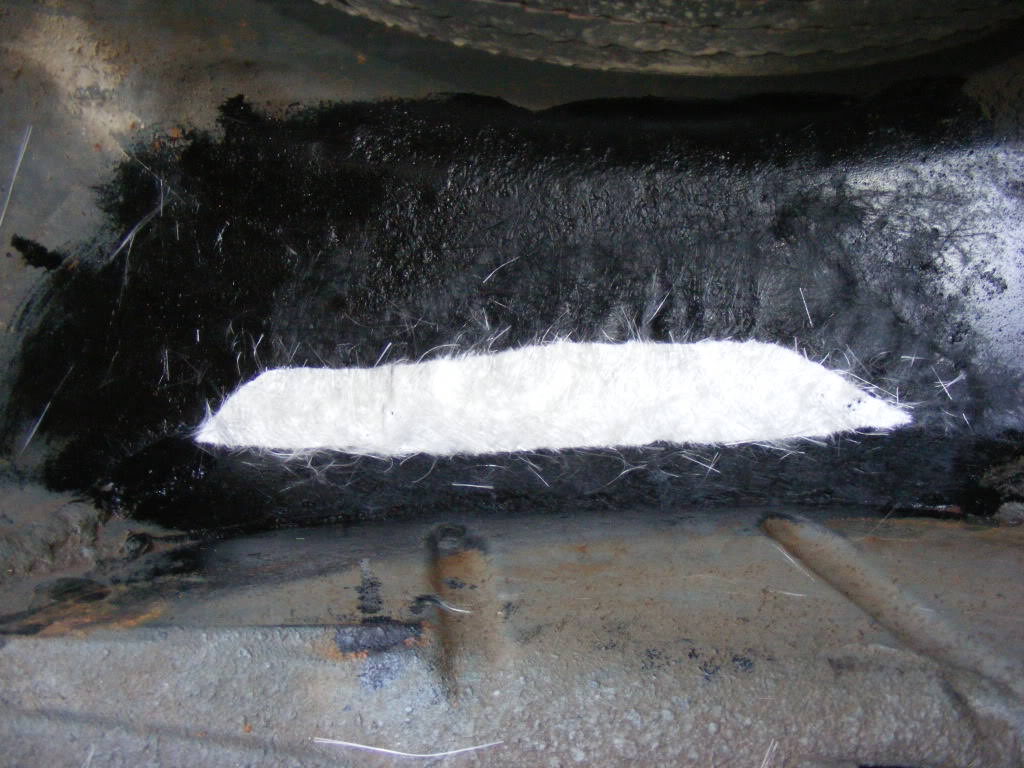
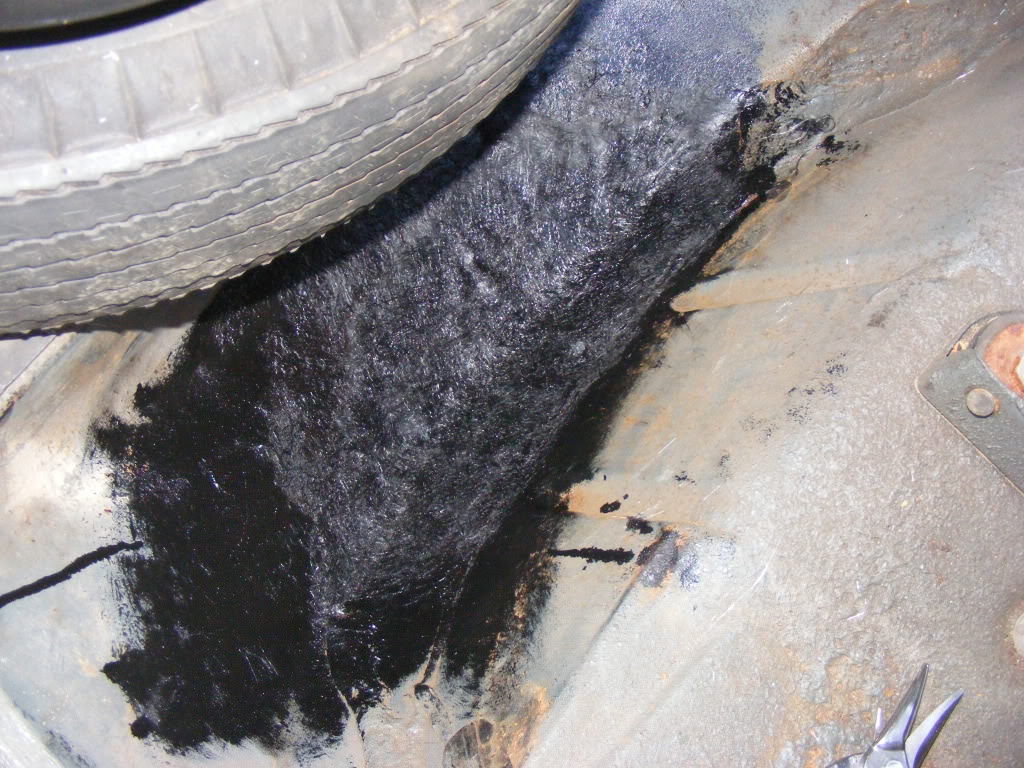
Take it one step further and use POR-15 instead of resin. Place the mat where you want it and "paint" it with POR-15. I've done this on similar rusted areas and was very happy with the results.

Here's a spot I did with a rusty spare tire well.

wHzjUO8.jpg


ltoZ92M.jpg
 
That's a real head-scratcher why some cars would rust there. Mine apparently didn't, the entire firewall was in great shape. This photo taken last July after going at it with wire wheels taken down to bare metal then painting the lower area with black DOM-16 (POR) and the top half with epoxy primer then 2K out of a can).

0500.jpg


I did have one or two very small rust-through areas under the wiper motor area, about the size of a dime, filled them with body filler.

I would take the grill off and go at the interior cowl with a leaf blower or compressed air with long wand, from both directions (top access and then the rusted seam) and clear out as much as possible. Then a water jet with soap. Once the seam is as clean as you can get it, I'd use POR on the exposed rusted edges (or POR on everything in the area), give it 24 hours and then use black 100% silicone caulk to fill the gaps. If you apply that stuff on a clean solid surface it will stick like you wouldn't believe and last decades. I get the idea of using tiger-hair filler but I think silicone will work better for these relatively hidden areas. After that, spray the inside (from the top, or maybe through small drilled access holes) with a non-drying undercoating, something like fluid film / Surface Shield / Wool Wax.
 
I concur on the POR-15 product use to encapsulate and stop the spread of the rust. Getting as much of the rust removed, first, as mentioned. There seem to be other "rust encapsulator" paints available, but POR-15 was the first one I saw advertised in the 1980s, so it has been around the longest. When done, some spray paint to spiff things up.

Take care,
CBODY67
 
Thanks for all of the great suggestions.

Does the COWL GRILLE PANEL come off without removing the hood?
 
Thanks for all of the great suggestions.

Does the COWL GRILLE PANEL come off without removing the hood?
Yes.
Remove the wiper arms first (that's a bit of a trick). Then there's the trim that runs right at the base of the windshield, it's held in place with about 4 - 5 clips on each side, just need a tool that goes under it and pry it up. There might be 2 screws - one on each end that you'll have to see and remove when you open the front doors. Probably also remove the windshield-washer-squirter nozzels. Then it's either philips-head screws or small 5/16 hex screws and the cowl comes off, you'll have to maneuver it past the wiper arm shafts. I took mine off without taking off the hood.
 
Yes.
Remove the wiper arms first (that's a bit of a trick). Then there's the trim that runs right at the base of the windshield, it's held in place with about 4 - 5 clips on each side, just need a tool that goes under it and pry it up. There might be 2 screws - one on each end that you'll have to see and remove when you open the front doors. Probably also remove the windshield-washer-squirter nozzels. Then it's either philips-head screws or small 5/16 hex screws and the cowl comes off, you'll have to maneuver it past the wiper arm shafts. I took mine off without taking off the hood.

I learned about How 2 Remove Wiper Arms this past December when demolishing Mathilda. I got all the wiper machinery off, intact, and in good usable condition. LOTS of little screws lurking in the cowl area. If it's JUST the arms, one needn't go there, but if one wishes to get inside, to repair sheetmetal, that's another trick. Maybe I shouldn't tempt this Innocent up that garden path.....
 
Last edited:
I also agree with using POR15. I used it and their "powermesh" fiberglass matting to repair some holes on my Toyota, underbody and wheel well. 10 years ago and still looking good. I was very very thorough with cleaning and prep though. Their patch that comes in a tube is good too for seams, cracks, and small holes. I've used that in various places, including repairing a cracked outdoor water valve. I pushed it in the crack and let it dry and it's been holding for years.
 
I have a new cowl drain flap coming from vans. The car is parked undercover during the winter with either a physical structure or a car cover. Thanks.
Perhaps you could blow some of the crap out of the cowl cavity wit compressed air. It's usually twigs and leaves that hold the water against the steel, promoting rust. Chrysler did not paint the insides.
Mike
 
I concur on the POR-15 product use to encapsulate and stop the spread of the rust. Getting as much of the rust removed, first, as mentioned. There seem to be other "rust encapsulator" paints available, but POR-15 was the first one I saw advertised in the 1980s, so it has been around the longest. When done, some spray paint to spiff things up.

Take care,
CBODY67
Generally I treat rust as people have discussed here, however, I'm wondering if what is often called " Rust Converter" is used by members?

It is essentially a phosphoric acid solution that is applied onto lightly contaminated areas of rust before any filling or painting is commenced.
With situations like this, which is very similar to that existing in my NY er when I bought her, I used phosphoric acid, and therefore all rust areas aren't removed, just bulk removal of flaky/loose corrosion and debris first, then wash with degreaser and water, before an overnight dry. Once dry the acid is liberally painted onto obvious rust and areas that are hard to access. A white finish after 8 hours or so indicates chemical change from iron oxide to some type s of iron phosphate.
These iron phosphates are very inert, apparently.
Then undercoat and fill/fibreglass the repair as you wish.
I've found that this chemical change from iron oxide ( rust basically) to iron phosphates makes the area stable for years, sometimes more than decades.
The only drawback to the product is that if you're not careful applying it, any phosphoric acid that gets onto good paintwork damages it very quickly(obviously), so masking/ coverage is essential around the work area.

 
Unless your going to own the car your entire life. leave it, could end-up making it look worse, the next owner will appreciate it
 
If you pull the cowl grill panel off, think about adding a piece of black window screen material underneath those slots. It is nearly invisible, and will keep 90% of the leaves, seeds, etc from getting down into the cowl. Anything small enough to go through the screen should wash right on through and not collect and rot in the corners and cause more of those rust holes.
 
Back
Top