
3d printing foam weather stripping / door seals

WissaMan

My hovercraft is full of eels
FCBO Gold Member
Joined
Sep 12, 2018
Messages
756
Reaction score
810
Location
Catawissa PA
Just an off-the-wall thought...

There are some desktop 3D printers that are designed to do continuous printing.


And there is foam-like filament

Flexible Filaflex Foamy filament

Got me wondering if this could be a solution for impossible-to-find weather seals. Printing would be painfully slow and the final product would not have the same surface finish as the regular foam seals. But if it creates a weather-tight/air-tight seal, it would maybe still be a better choice than nothing at all.
 
You realize that other than the basic joints and end plates, the rest of the rubber weatherstrip is hollow?

You might try a section and see how it goes. Issues would be "crushability" or "conformity" of the medium and its all-weather durability, I suspect. Cost of the materials?

Just some thoughts,
CBODY67
 
Just an off-the-wall thought...

There are some desktop 3D printers that are designed to do continuous printing.


And there is foam-like filament

Flexible Filaflex Foamy filament

Got me wondering if this could be a solution for impossible-to-find weather seals. Printing would be painfully slow and the final product would not have the same surface finish as the regular foam seals. But if it creates a weather-tight/air-tight seal, it would maybe still be a better choice than nothing at all.

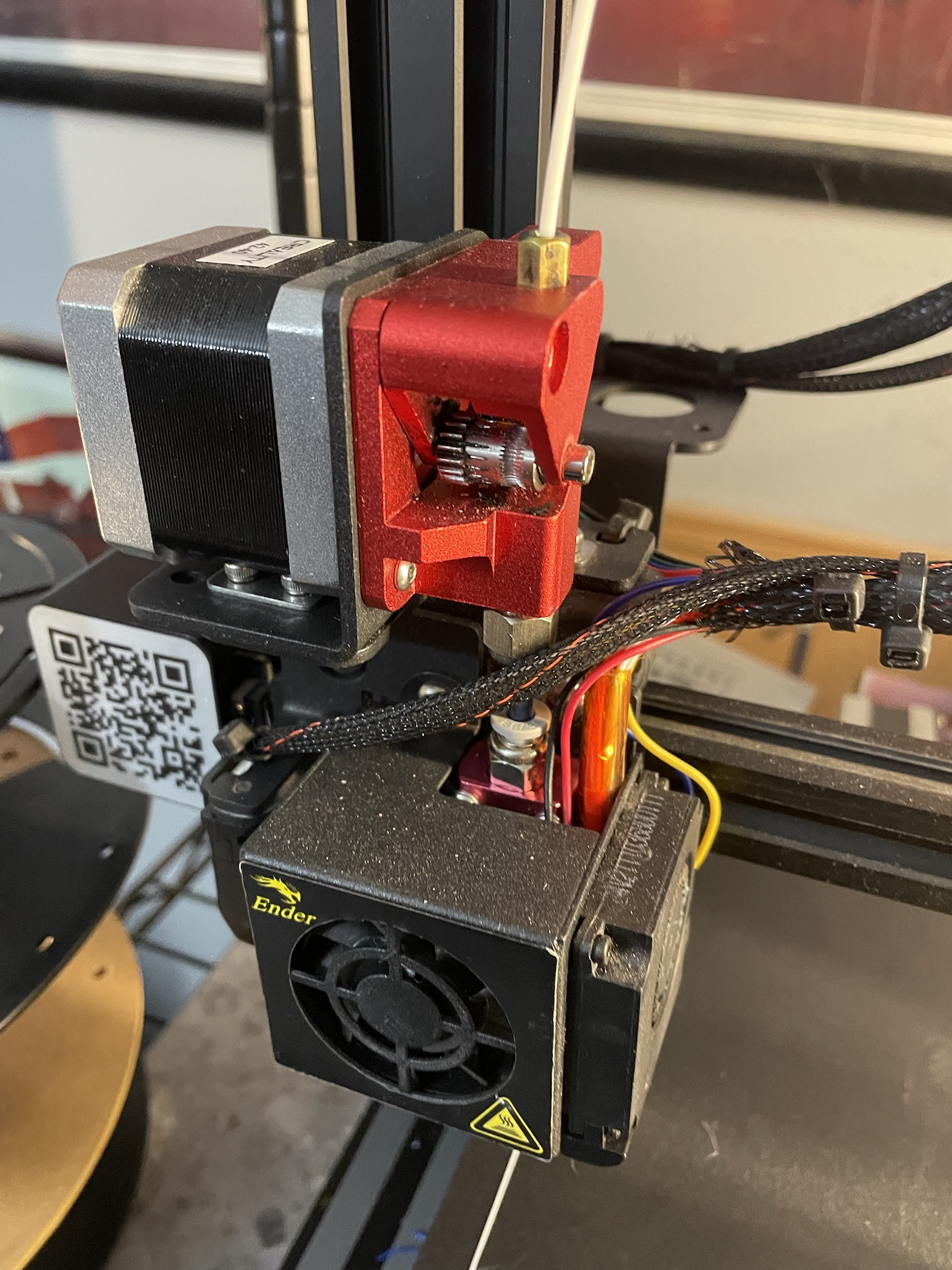
The issue that I see is the long Bordon tube. I've tried to setup to print some TPU and the mod that is recommended is to go to a direct drive where the extruder is mounted on the hot end. From what I read, TPU doesn't like to be pushed down the Bordon tube and the tube on that unit is longer than most.

So, if you can get around that, and I think it's possible, it should work. A little pricey to buy that printer though.

The direct drive attached to my Ender. The Bordon tube ends up being about 1/2" long.

Izsa0P7.jpg
 
I didn't realize it doesn't have direct drive into the extruder. But it does indicate it is compatible with TPU.

Regarding the seal design, I don't see why it couldn't be designed and printed with hollows inside. Or at the very least, a very low-density/weak infill.

I ordered some of that filament, just because I'm a curious sort.
 
What kind of filament would you use for weather-strip?
 
I didn't realize it doesn't have direct drive into the extruder. But it does indicate it is compatible with TPU.

Regarding the seal design, I don't see why it couldn't be designed and printed with hollows inside. Or at the very least, a very low-density/weak infill.

I ordered some of that filament, just because I'm a curious sort.
Yea, the TPU doesn't like to be pushed because of its softness. That doesn't mean it won't work at all. The way I understand it, you may have some feed problems or possibly some inaccuracy in the feed.

But try it and report back. I was trying to make some body plugs with TPU and I wasn't having a lot of luck getting it to look decent, so I shelved the project for a bit.
 
I don't know if you mess around with 3d resin printing, but they make all sorts of resins for those too, including TPU-like. For making things that look good, resin printing gives much better results, but comes with it's own trials and tribulations, limitations, and learning curve. But there are certain things that require one or the other. For instance, with my door lamp lens, I come to realize that filament printing isn't going to work because if the door is open for a while, the heat from the light will cause the 3d filament to soften and distort. Maybe using LEDs would reduce the temp, but even those get warm after a while. Whereas resin prints have much better temperature tolerance. But it's also possible it may yellow over time from UV exposure. I'll update that other thread at some point with my resin printed lens that looks and works better than the filament printed lens.

What kind of filament would you use for weather-strip?

This stuff Flexible Filaflex Foamy filament

I have an Elegoo 3d printer which feeds soft filaments well. About the only thing I haven't been able to print with is a wax filament used for lost-wax casting.

I have also pondered the idea of using an expanding foam and forms to make seals. Making long ones would be a challenge, but it might work for making end pieces. SmoothOn has what looks like a product that might work for that. Would need a good example piece, then do a 3d scan to make a form. It'd all be a lot of work, but for unobtainium it could be a viable solution.
 
I don't know if you mess around with 3d resin printing, but they make all sorts of resins for those too, including TPU-like. For making things that look good, resin printing gives much better results, but comes with it's own trials and tribulations, limitations, and learning curve. But there are certain things that require one or the other. For instance, with my door lamp lens, I come to realize that filament printing isn't going to work because if the door is open for a while, the heat from the light will cause the 3d filament to soften and distort. Maybe using LEDs would reduce the temp, but even those get warm after a while. Whereas resin prints have much better temperature tolerance. But it's also possible it may yellow over time from UV exposure. I'll update that other thread at some point with my resin printed lens that looks and works better than the filament printed lens.
I do some resin printing too, but didn't know there was a TPU type resin. That is very interesting and I'll have to look into that.
 
I've worked with some resins from Resione that are flexible. F69 is one of them. It's really viscous but the pieces I made are like rubber. Siraya Tech has some good resins too. I used their crystal clear "Blu" resin to make the lens. That is not as flexible but has some give and can flex without breaking. There's always new stuff being developed too. It's pretty amazing what is available, but the challenge is with every new resin you try (and filament for that matter) you've got to tune it in for your printer, which I'm sure you're familiar with those headaches!
 
BTW, if you're looking for a soft (non-foaming) filament, check out Fillamentium Flexfill 92A. It's softer than regular TPU but it's no harder to print with in my experience. The prints have properties similar to rubber.
 
Back
Top