New Yorker - 65 vs 66

Cadillacdave

New Member
Joined
Jan 23, 2022
Messages
32
Reaction score
4
Location
32837
Looking at both a 65 New Yorker with a 413 and a 66 New Yorker with a 440. Both cars are original, good shape etc.

Which car do you guys prefer and why. Is the 440 much better than the 413?

Thanks in advance for the advice and opinions.
 
Looking at both a 65 New Yorker with a 413 and a 66 New Yorker with a 440. Both cars are original, good shape etc.

Which car do you guys prefer and why. Is the 440 much better than the 413?

Thanks in advance for the advice and opinions.
IMHO, the difference between the '65 413 and the '66 440 is negligible. Both will perform about the same in that car and finding parts for either engine won't be a problem. The '66 440 still has the smaller (1.60") diameter exhaust valves, same as the 413 and I think just about every part except the pistons are shared between the two engines.

It comes down to what you want. I happen to prefer the '65.
 
Last edited:
To bad you have to make a choice, any pictures? What colors? Interior? I prefer 65.
 
There are lots of things to like about both. The headlight covers were neat (when new), but had some issues related to condensate on the glass, as I recall, back then.

Both cars look really good and luxurious in their body styles.

Otherwise . . . the '65 was the first year of the formal C-body platform. Usually, there are some mechanicals which carry over from the prior platforms. One is the shift cables, operated by the steering column shifter rather than the prior pushbuttons. I'm not sure how "close" the two cables are to each other, just that the '65 uses cables as the '66 uses hard linkage (as later model years). This is something I've known about for decades, but never did "worry about it" until more recently. Seems like the parking brake system (on the rear of the transmission tail shaft housing) and rear axle shafts are left-overs from the prior-era platform? 22" wide radiators on factory a/c cars rather than the 26" of '66s?

Nothing the matter with the 413s. The 440s were new in '66 with more power and the then-new 256/260 cam. Both engines have the same-spec cyl heads, basically. For a normal street-driven motor, the exh valve size is not really that important, to me. Just that the engine starts and runs quickly, quietly, and efficiently.

Like most 2nd-year versions of a new platform, the 2nd years are usually more visually and mechanically refined, by observation. Not that the first year cars are bad, just that the 2nd year cars are better-still. Kind of like the design team upgraded or fixed a few things? As the mechanicals for the '66 carried well into the '68 model year and beyond, which is a plus to me.

At the end of the day, it's . . . going to be YOUR car, bought with your money to chase your dreams. Make the best purchase decision just like any other car you might buy. BOTH are still Chryslers built to Chrysler's standards of that era.

Pictures of your final purchase?

CBODY67

I like the styling of BOTH cars, inside and out. The mechanical differences can be dealt with, too.

 
Mechanically they are so close it’s almost a non factor IMO. Styling wise, look for what appeals to you the most. I personally like the “glasses” that are on the ‘65. Either one would be a win. Keep us posted and post pics. Good luck.
 
The 440s were new in '66 with more power and the then-new 256/260 cam
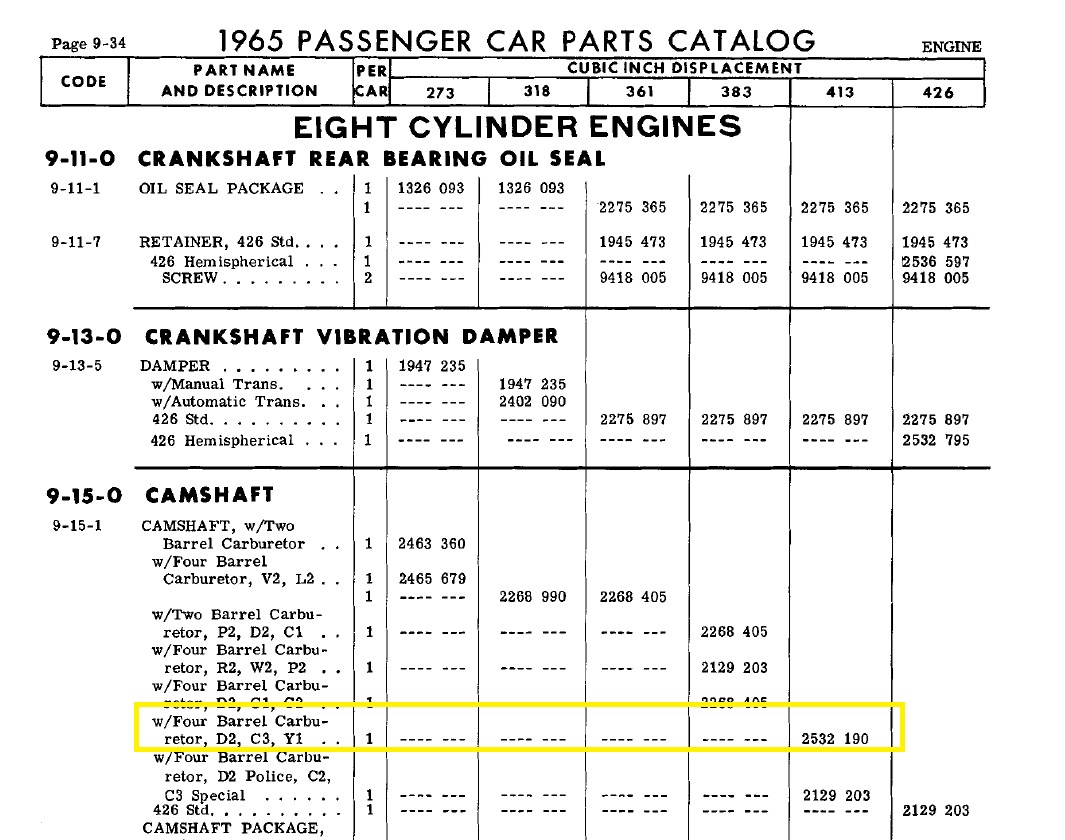
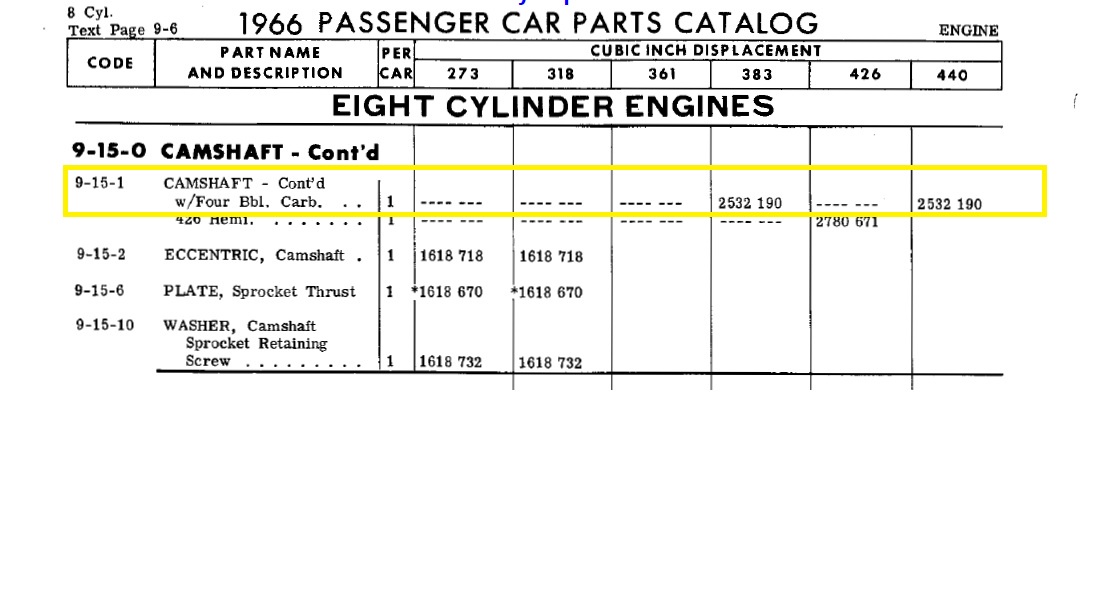
'65 New Yorkers with the standard 413 and '66 New Yorkers with the 440 (both standard and optional engines) used the same camshaft.

Camshaft65.jpg


Camshaft66.jpg
 
I prefer the '65; better grill and taillights. I also prefer the 413 to the 440, especially in the area of gas milage.
 
'65 New Yorkers with the standard 413 and '66 New Yorkers with the 440 (both standard and optional engines) used the same camshaft.

View attachment 740983

View attachment 740984
Image links inop. In looking at the '65 FSM, the 413/340 cam was indeed 256/260, with .430" lift on both intake and exh valves. Looking in the '66 FSM, the 256/260 cam in all 4bbls that model year (383 and 440) were 256/260, but with different lifts for '66, .425" intake and .435" exhaust.

Are those differences within the margin of error for measuring devices? Or different measurements? To me, though no significant difference in performance anywhere except on the engine dyno. So, "a wash", in reality, as to performance?
 
Image links inop. In looking at the '65 FSM, the 413/340 cam was indeed 256/260, with .430" lift on both intake and exh valves. Looking in the '66 FSM, the 256/260 cam in all 4bbls that model year (383 and 440) were 256/260, but with different lifts for '66, .425" intake and .435" exhaust.

Are those differences within the margin of error for measuring devices? Or different measurements? To me, though no significant difference in performance anywhere except on the engine dyno. So, "a wash", in reality, as to performance?
The new "upgrade" seems to not allow for uploaded images... Sigh....

I posted the '65 and '66 Parts manual and the part numbers are the same for the standard '65 New Yorker 413 and all the '66 440 engines, both standard and high performance versions. Part #2532190.

1967 standard 440 also used the #2532190 cam but the high performance 440 used #2843564.

Now, the high performance '66 440 was 365HP and the high performance '67 440 was 375HP. The high performance '67 440 also had the larger 1.75" valves.

Of course, IMHO, New Yorkers weren't generally sold with high performance engines in them, so comparing the base, standard engines is probably more "apples to apples".

Now, it is possible that the part number listed is the "service" camshaft. It's also possible that either the FSM or the parts manual is missing something, but I tend to side with the parts manual as that was updated/revised through the year where the FSM was a pre-production manual that didn't get updates. We have to go by what is in front of us though.... Bottom line is there isn't a whole heck of a lot of difference between the '65 and '66 in standard form and any "seat of the pants" difference will be more about engine condition and state of "tune".


Y9AIwgZ.jpg

nwogf3b.jpg
 
IMHO, the difference between the '65 413 and the '66 440 is negligible. Both will perform about the same in that car and finding parts for either engine won't be a problem. The '66 440 still has the smaller (1.60") diameter exhaust valves, same as the 413 and I think just about every part except the pistons are shared between the two engines.

It comes down to what you want. I happen to prefer the '65.
The 65 is very nice. The tail lights, trunk and rear of the car look fantastic.
 
To bad you have to make a choice, any pictures? What colors? Interior? I prefer 65.
66 is a four door hard top, sand beige color, nice cloth interior, power windows, power brakes and power steering, but no AC. 65 is a 2door, light green, has vinyl interior, low optioned car, no AC but has power steering and power brakes.
 
Image links inop. In looking at the '65 FSM, the 413/340 cam was indeed 256/260, with .430" lift on both intake and exh valves. Looking in the '66 FSM, the 256/260 cam in all 4bbls that model year (383 and 440) were 256/260, but with different lifts for '66, .425" intake and .435" exhaust.

Are those differences within the margin of error for measuring devices? Or different measurements? To me, though no significant difference in performance anywhere except on the engine dyno. So, "a wash", in reality, as to performance?
Thanks for all of the useful and informative responses. It seems that most favorite the 65. Both nice looking cars. The 65 is a 2 door and the 66 is a 4 -door. Neither has AC. I actually prefer the cleaner look of the headlights and grill on the 66, but the rear tail lights on the 65 look great.
 
There are lots of things to like about both. The headlight covers were neat (when new), but had some issues related to condensate on the glass, as I recall, back then.

Both cars look really good and luxurious in their body styles.

Otherwise . . . the '65 was the first year of the formal C-body platform. Usually, there are some mechanicals which carry over from the prior platforms. One is the shift cables, operated by the steering column shifter rather than the prior pushbuttons. I'm not sure how "close" the two cables are to each other, just that the '65 uses cables as the '66 uses hard linkage (as later model years). This is something I've known about for decades, but never did "worry about it" until more recently. Seems like the parking brake system (on the rear of the transmission tail shaft housing) and rear axle shafts are left-overs from the prior-era platform? 22" wide radiators on factory a/c cars rather than the 26" of '66s?

Nothing the matter with the 413s. The 440s were new in '66 with more power and the then-new 256/260 cam. Both engines have the same-spec cyl heads, basically. For a normal street-driven motor, the exh valve size is not really that important, to me. Just that the engine starts and runs quickly, quietly, and efficiently.

Like most 2nd-year versions of a new platform, the 2nd years are usually more visually and mechanically refined, by observation. Not that the first year cars are bad, just that the 2nd year cars are better-still. Kind of like the design team upgraded or fixed a few things? As the mechanicals for the '66 carried well into the '68 model year and beyond, which is a plus to me.

At the end of the day, it's . . . going to be YOUR car, bought with your money to chase your dreams. Make the best purchase decision just like any other car you might buy. BOTH are still Chryslers built to Chrysler's standards of that era.

Pictures of your final purchase?

CBODY67

I like the styling of BOTH cars, inside and out. The mechanical differences can be dealt with, too.

62 was the last year for the transmission mounted parking brake.

64 was the last of the tapered rear axle shafts.

The 65 has the orphan 1 year only driver's side engine mount. The rubber mount is hard to find. It can also complicate installing a later model engine should the need arise, because the boss where the bracket bolts to the block is not drilled on a lot of later blocks.

I prefer the 65 styling, both inside and out, but not enough to not buy a 66 if it was a better car than another 65.

Kevin
 
62 was the last year for the transmission mounted parking brake.

64 was the last of the tapered rear axle shafts.

The 65 has the orphan 1 year only driver's side engine mount. The rubber mount is hard to find. It can also complicate installing a later model engine should the need arise, because the boss where the bracket bolts to the block is not drilled on a lot of later blocks.
Thanks for those verifications.

CBODY67
 
Thanks for those verifications.

CBODY67

Another anomaly to a 65 Cbody is that while the automatic transmissions were slip yoke, the 4 speed was still ball and trunnion even though the A and B body were slip yoke.

I can only guess that they used 1964 surplus B body transmissions to use them up, and there was likely more in stock than projected sales.

1 run of B&T drive shafts would be cheaper than new updated transmissions, especially if the hardware is already in stock.

Kevin
 
Another anomaly to a 65 Cbody is that while the automatic transmissions were slip yoke,
The '65 and '66 New Yorkers also have the double cardan front joint like the Imperials, but unlike the Imperials, just a single rear joint.
 
Back
Top