Headlight relays for twin lights.

VALNUT

New Member
Joined
Aug 14, 2014
Messages
27
Reaction score
3
Location
Australia
I'm starting to get little crappy jobs done on my 880 and next up is to get the lights working properly.

My question is, do I put a relay on for each of the lights? As in, The 880 has separate hi beams. I am guessing 1 for high and 1 for low beam is the way to go after reading a bit.
Where should it be wired to? Is the hot wire coming from the dip switch on the floor or is it coming straight from the light switch on the dash?

I now it's a simple job but i just have to get my head around it first. I have a wiring diagram so I'll study that a bit more tonight as well.

Thanks.
Val
 
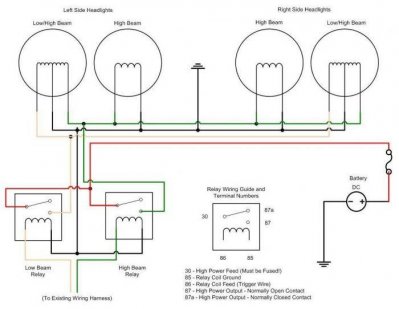
I did mine under the hood. One relay for lows, one for highs (brights). Basically took the current power wire for the lights, cut it, and directed it to the signal (86) terminal of the relay (we'll call this the bulk head side). Connected the output from Output (87) back to the lights side of the original power wire. This diagram might help, it's exactly what I did. Well I added fuses to the circuits as I don't like the idea of fire for lack a $.50 chinese made fuse.


102696d1210788932-gtv6-headlight-conversion-relay-headlightrelaywiringdiagram.jpg

102696d1210788932-gtv6-headlight-conversion-relay-headlightrelaywiringdiagram.jpg
 
The only thing I would suggest different from the above post is two circuit breakers rather than the single fuse. One breaker for the lows and one for the highs. That way, if there is an issue, you still have a good chance of one circuit still working. That is sometimes the difference in getting you home.

I like breakers over fuses for this application. Same protection, just you don't have to worry about carrying fuses... and if there is an intermittent short, or some sort of extra draw, you may still have lights without blowing the handful of fuses you had on hand finding the problem.

Also, make a set of jumper wires to bypass the relays and carry them in the glove box... again... to get you home if needed.
 
Carry a spare relay too. They do fail sometimes.

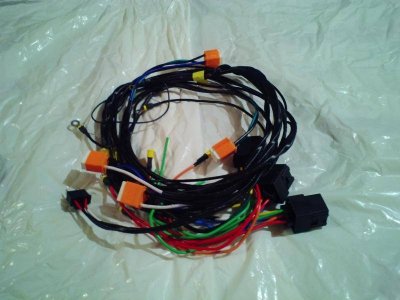
You can buy a prewired aftermarket harness, like the one from Putco, or you can make your own.

Like I did.
096.jpg

I had a whole ****load of Mopar relays, so I decided to use some of them. I used #12 wire for all of the load circuits, switching circuit got #18 wire. I prefer circuit breakers for this application too.

As an option, if you're just upgrading to Halogen Sealed Beams and your Headlight Switch is still good, you could just use relays for the inside pair of lights. The outside pair of Halogen sealed beams are only 35/35 Watts, which is less wattage than the original sealed beams were. At 50 watts each, it's the inside pair of Halogen sealed beams that will cook your Headlight Switch.

096.jpg
 
The only thing I would suggest different from the above post is two circuit breakers rather than the single fuse. One breaker for the lows and one for the highs. That way, if there is an issue, you still have a good chance of one circuit still working. That is sometimes the difference in getting you home.

I like breakers over fuses for this application. Same protection, just you don't have to worry about carrying fuses... and if there is an intermittent short, or some sort of extra draw, you may still have lights without blowing the handful of fuses you had on hand finding the problem.

Also, make a set of jumper wires to bypass the relays and carry them in the glove box... again... to get you home if needed.


Yeah I fused lows and highs separately. Took a bit of noodling to get the right fuses sizes, I went considerably lower than the factory had for the circuit.
 
I did mine under the hood. One relay for lows, one for highs (brights). Basically took the current power wire for the lights, cut it, and directed it to the signal (86) terminal of the relay (we'll call this the bulk head side). Connected the output from Output (87) back to the lights side of the original power wire. This diagram might help, it's exactly what I did. Well I added fuses to the circuits as I don't like the idea of fire for lack a $.50 chinese made fuse.


View attachment 63418

The only thing I would suggest different from the above post is two circuit breakers rather than the single fuse. One breaker for the lows and one for the highs. That way, if there is an issue, you still have a good chance of one circuit still working. That is sometimes the difference in getting you home.

I like breakers over fuses for this application. Same protection, just you don't have to worry about carrying fuses... and if there is an intermittent short, or some sort of extra draw, you may still have lights without blowing the handful of fuses you had on hand finding the problem.

Also, make a set of jumper wires to bypass the relays and carry them in the glove box... again... to get you home if needed.

Yeah I fused lows and highs separately. Took a bit of noodling to get the right fuses sizes, I went considerably lower than the factory had for the circuit.

These are awesome suggestions! Thanks guys. As to the breaker or fuse size... never go bigger than the rating of the smallest current carrying device, possibly your original headlight sockets or ground wire. Lots of cars of this era died because a headlight switch melted/shorted and even new cars sometimes do. I have personal seen about a half dozen fires either as they happened or after the fact due to this.
 
Just run your triggers off the current headlight plugs...high and low beam...then if your new harness decides to crap out on you, all you have to do is unhook the relay harness and plug the original system back in. ;) This is how I did it on my old Cummins crewcab conversion.
 
Also if you want a plug and play kit custom made with top quality components and wiring you can head over to FABO and hit up member CRACKEDBACK. he makes an amazing conversion kit and its very inexpensive.
 
Back
Top