brake booster rebuilt, now brakes are WAY TOO sensitive!

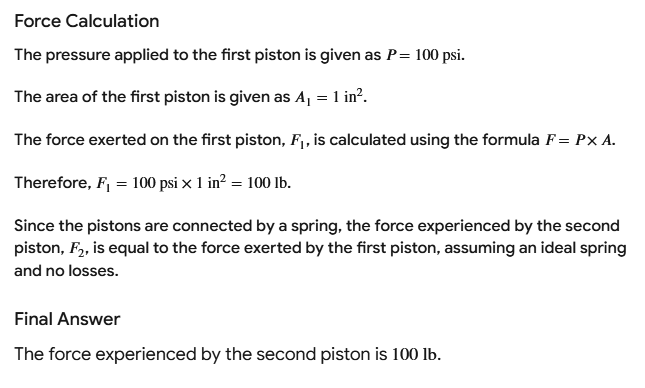
force of 100 psi is applied to a piston with area 1 square inch, which is connected by a spring to a second piston of area 1 square inch. What is the force experienced by the second piston?
piston-force-spring.gif
I think one thing where we are talking apples and oranges is PSI versus force. I'll take the hit for not labeling my values. I've edited this drawing to show what the force would measure if there was a scale at the top piston and one at the bottom. It was clear in my head what I was talking about, but I didn't convey that in my drawing.

No AI Here4.jpg
 
I think now the spring does need to be in the MBC between pistons, to equalize the pressure of the 2 circuits (front and back lines). If there was a solid shaft connecting them, then you are guaranteeing that the exact same amount of fluid will flow out of both ports when the pistons move. But because of shoe or pad wear or adjustment differences one or the other circuit may reach rotor or drum contact first and that will effectively end pedal travel regardless if the other side (ie front or back brakes) have more room to move.
 
I think one thing where we are talking apples and oranges is PSI versus force. I'll take the hit for not labeling my values. I've edited this drawing to show what the force would measure if there was a scale at the top piston and one at the bottom. It was clear in my head what I was talking about, but I didn't convey that in my drawing.

View attachment 733728

I think that, according to your physics, this should work:

boat-fan.jpg
 
Thanks for posting that. I read through it and I have a much better understanding of how the dual MC works and it's much more involved than I thought it was. In retrospect, I should have done some research on this.

I said I was done with this thread, but I have to acknowledge this helpful post.
 
From the 1970 Chrysler Master Technician Service Conference, Volume 70-9: Brake Hydraulics:

Full volume available at My Mopar - MTSC 70-9.

Also see My Mopar - '76 December Reference Book - Hydraulic Fundamentals and 64-4 Hydraulic Fundamentals.


THANK YOU Vaanth, for including the rigorous documentation from the '70 and '76 MTSC, Reference Book et cetera. The detailed illustration and explanation of the master cylinder clarifies how both hydraulic and spring forces work to optimize braking.

Again, I salute YesterYear's Engineers for the work they achieved with slide rules, log tables, martini's and cigars!
 
Back
Top